Showing posts with label educational sciences. Show all posts

Wednesday, December 28, 2022

When Educators Use the Word "Science" and the Need for Critical Thinking

 "Science can be a language of distance which reduces a being to its working parts; it is language of objects."  Robin Wall Kimmerer, Braiding Sweetgrass

Educators and education policymakers have discovered a new word "science." Well, it's not new to them, but some educators have figured out that by placing the words "Science of" before whatever topic they wish, somehow transforms that topic into something that is to be heeded and given authority. For example, I remember some state level educators throwing around the words "Science of Change" or "Science of Innovation" at a professional development session pushing some new curriculum scheme the state wanted to be accepted. It's as if by talking about "change" being a "scientific discipline, it should be accepted without question. Never mind that often with change, the important questions are not scientific at all. The questions of value, like "Who is affected by this change?" and "Who gains the most from this change?" are extremely important as well. Change and innovation are too often pushed for their own sake, or for the sake of some career that stands to gain from its implementations. 

We need to realize that the placement of the word "Science" before change, or innovation, or, most recently, "Reading" does not make the contents of that field any more legitimate and immune to critique. In fact, we should turn on the critical thinking even more when educators throw around the word science in this manner, because they have done it so often in the past...like at the turn of the 20th century with the term eugenics. At that time, education leaders and policy makers did a great deal of talking about the science of eugenics too, and we all know the ethical issues with that science.

As Kimmerer points out, it is important to understand the effects of imposing the language of science on anything, even reading. It creates a distance between us and that object. It tears it down into working parts pretty well, but in the end, you sometimes don't understand it any more than when you started your "scientific study." Sometimes, an act like reading needs to be understood as a whole too. If we reduce the act of reading too much as some kind of simple skill that can be taught, we actually ignore the fact that reading is really a personal, meaning-making experience too among other things. It is actually a subversive activity too if we let it be.

Educators always need to be skeptical of their colleagues and educational gurus throwing around the word science. It's very appropriate to ask tough questions, even the questions they would like to be out of bounds.

Sunday, July 17, 2016

Teachers Impact Students' Lives in Immeasurable Ways

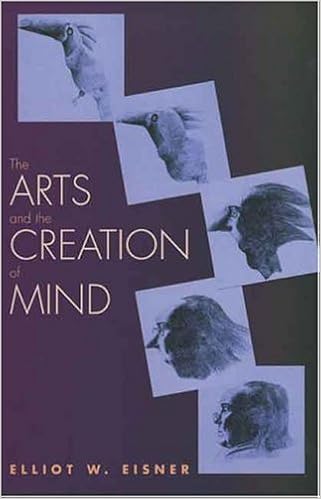
"The effects of teaching may not show up until long after students leave school and in ways the teacher never dreamed of." Elliot Eisner, The Arts and the Creation of Mind
How do you measure the true educational impact of a teacher? If you consult psychometricians, they say it is simple. You pre-test, deliver instruction, and you post-test. On this our "educational sciences" are based. But do these tests really measure the teacher's most important impact on students' lives? Is the most important task of a teacher to demonstrate that they can "improve a student's test scores?" And, equally important, no matter what our state and federal education bureaucracy tells us, "Are these state standardized test results really capturing learning that will be meaningful to those students' future lives, or are these results simply better predictors on how students will score on other standardized tests?"

Elliot Eisner's book, The Arts and the Creation of Mind depicts an image of a teacher that is much more complex and complete than that currently promoted by the "education sciences" to which modern education finds itself enslaved. The teacher is much more farsighted than the teacher who can't wait for the latest standardized test scores at the end of the year. Eisner's teacher is an "environmental designer" who "creates" situations and places where students gain "an appetite to learn."

Eisner's teacher is not a technician who uses "test data" to choose "canned scripts" and the latest adopted "scientifically validated methods and curriculum" whose purpose, is not to inspire wonder and imagination, but whose purpose is to make some education administrator or politician feel like they are effectively improving education. The teacher should not be teaching by following recipes; they should be engaging students in a "mind-altering curriculum" that forever changes them into forever learners.

What's wrong with the current grip that so-called "education sciences" have on schools is that they have created an impoverished, assembly-line form of education that students don't have to participate in; they only need to be subjected to it. Our education system still strives to run "smoothly," in a standardized manner and as efficiently as possible, and to get as many students through the credentialing process. It is short-sighted and its vision can't see beyond the "testing extravaganza at the end of the year.

But as Eisner makes clear in his book, if you really want "educational gold" in the classroom, then a "high-degree teaching artistry is needed. You need classrooms of "improvisation and unpredictability," not classrooms constructed according to rigid scientific principles. The teacher, in this innovative and creative classroom, is not a scientist who constantly studies the latest test data and looks at his repertoire of "research-based, scientifically-validated" classroom scripts for the one to apply because the data indicates it is called for. The teacher is what Eisner calls "a midwife to the child's creative nature."

As I look back at my years in elementary school, I see one teacher who I would really say was the midwife to my own creative nature. She didn't make noise about my performances on tests. She genuinely questioned and encouraged me when I showed curiosity in the solar system, astronomy, biology, tadpoles, frogs, and trees. She listened attentively when I read stories I had written aloud in class and encouraged me to write more. She encouraged me to read anything and everything I could get my hands on in our school library, even helping me get permission from the librarian to wander into and check out books from the "junior high section" instead of the elementary section where all six-graders were constrained. I read more books that year than perhaps in any other time of my life because of her. In a word, she designed an environment that helped me grow my curiosity and a massive appetite to learn that is still alive today.

My greatest concern with the Standards-Standardized-Testing-Research-Based-Accountability educational milieu we've created in our schools is the damage it is doing to students far into their futures. Does all this focus and obsession with test scores really matter in the lives of our students? The true impact we have on student lives is an impact that hasn't happened yet, and its an impact that can't be measured by standardized tests. My sixth grade teacher had no idea that the classroom environment she created would mean that I would become a teacher myself. She had no idea that I would become a principal. She also had no idea that my passion for reading, writing, and appetite to learn would stay with me the rest of my life.

Perhaps if we really want to focus on "student outcomes" we need to set our sights beyond test data and create places of imagination, creativity, and innovation where curiosity is treasured, learning is not just measured, but valued. Not everything worthwhile can be reduced to pre-tests and post-tests, and the real impact of our work with students will be measured by the lives they live far beyond the classroom.