Showing posts with label 21st century learning models. Show all posts

Wednesday, May 28, 2014

Turning Your Classrooms from Places to Control Students to Places to Engage Them in Learning

“For the first time in the history of education, the teacher, the student, and the content do not need to be in the same place at the same time.” Ian Jukes, Windows on the Future
NewImage

How we handle the details of designing our “learning spaces” ultimately determines what happens in our classrooms. As Jukes points out, for the first time in history students and teachers do not even have to be in the same place when learning. Also, the content is no longer confined to textbooks. Still, our schools’ classrooms are designed for “imparting knowledge” not engaging in authentic learning. I would bet if you look at any recent plan drawn up for a new school, the spaces are still designed for traditional factory model learning. The classrooms are arranged like so many pods with desks sitting in rows with a teacher desk placed at the front of the room with a whiteboard located behind. What many still do not quite understand is  a simple principle of classroom design: How you plan the learning space ultimately determines the kinds of learning that happens in that space. Even the furniture selections can impact the learning that happens.

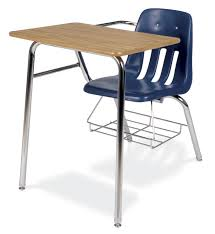
Take the student desk as an example (like the illustration above). These desks are still everywhere in our schools. When new schools are built, hundreds of these are ordered and then placed in neat rows in classrooms. But this particular desk is problematic if we are looking to create learning spaces where students collaborate and engage in active learning. These desks are designed to be placed in rows and to actually restrict the movement of the student sitting in it. Have you ever complained about how hard it is to move and get out of these things? But in a factory era school, student movement is discouraged and what better way to do it than by designing a desk that minimizes the movement of students? These desks are perhaps a symbol of what’s amiss about so-called 21st century education today. We still think of learning spaces as ways to control students rather than ways to engage them in real learning.

I have no way of knowing whether those who designed the first student desks in this manner really had the goal of making a desk that restricted movement, but the fact that so many of these still exist in our classrooms is symptomatic of a greater problem: We just can’t let go of the idea that schools are factories whose job is to churn out students who have been declared educated through testing and credentialing. “Get’em through the system like widgets and declare them graduated and educated if they make through the hurdles and tests.” In our classroom learning spaces we still buy furniture whose purposes is to control and attempt to make learning fit into neat orderly boxes, when those of us who’ve been teachers for some time know real learning is messy and not always subject to the controls we place on it. We keep arranging our schools’ classrooms for teacher-directed instruction instead of designing them for student-directed and inquiry learning which we know is how most of our students want to learn. In a word, for all our talk, we are trying to fit 21st century learning into classrooms designed for factory-model education systems.

Obviously, my point is obviously not to get you to throw out all the student desks in your buildings. But, the question is, how can we re-envision our learning spaces to make authentic, engaging learning happen for our students? We can begin by looking at our current classrooms and see how we can transform them from places to control to places to explore and engage learning. This doesn’t really cost us very much either.

Wednesday, April 17, 2013

21st Century Perspective on Creating Innovative School Schedules

“If time is not fixed, there are lots of possibilities to make schooling more responsive to the individual needs of students and teachers and more economical to operate.” Frank Kelly, Ted McCain, and Ian Jukes, Teaching the Digital Generation: No More Cookie-Cuter High Schools
Why do high schools keep the same master schedule from one year to the next? One of the most difficult lessons I have learned as principal of an innovative high school is that there is no law or policy that prescribes what the school’s master schedule should look like from year-to-year. In fact, innovative high schools see schedule-flexibility as a must in order to fit the schedule to student needs, rather than fit students to a schedule.  This is my fourth year in my current position, and the master schedule has changed every year, and it looks like it will change again this year. Our master schedule is truly responsive to the individual needs of our students and our staff and that is how it should be.

Most high schools define themselves by their schedules. For example, a four-by-four high school defines itself by consistently having 4 periods of instruction a day in classes that last for one semester. In contrast, a traditional schedule high school defines itself as having 6 or 7, possibly 8, discrete periods of instruction a day that last for a calendar year. Then there’s blended models that incorporate aspects of both, as well as schedules that include some even shorter blocks of time for enrichment periods or advisory periods. The bottom line though is that most high schools do define themselves by their schedules, and that schedule is a fixed entity.  They see their schedule  as something that cannot be changed from year to year. But what if that schedule were seen as a flexible component that could be adapted to fit the needs of students from year to year? I submit that 21st century high school leaders view master schedules, not as a fixed entities to which students are fitted, but instead view schedules as just another tool to meet the needs of students.

For example, one of our commitments as a high school is to try to keep our class sizes down. In an age when individuals like Bill Gates argue that “Class size doesn't matter” my staff and I believe wholeheartedly it does matter. While it might not matter if your only yardsticks are test scores, we know from our personal experience the size of a class does matter when it comes to teachers being able to form significant relationships with the students they teach. These relationships are more than just about making our students get higher scores on the latest standardized tests. Smaller classes are about relationships and making our school a humane place to learn, instead of a factory that churns out “high-test scores” each year. And, to keep those class sizes down in the past several years, we have changed our schedule so that we do not have 35 students sitting in classrooms.

The bottom line about scheduling should be simple. School leaders need to change their perspective on schedules and master scheduling, and be flexible. Twenty-first century learning demands it. Instead of viewing the schedule as a fixed element that is not subject to change from year to year, why not view it as simply another tool in the tool chest to better meet the needs of your students? That’s being a 21st century leader in innovation.

Just to give you an idea on what we’re doing. Here’s our proposed schedule this year. I have to thank my guidance counselor for coming up with this one.

Period Times
1st Period (Semester-Long Class? 7:40-9:10
2nd Period (Year-Long Class) 9:12-10:02
3rd Period (Year-Long Class) 10:04-10:54
4th Period (Year-Long Class) 10:56-11:46
Enrichment Period (Also advisory Period) 11:48-12:33
Lunch 12:33-1:05
5th Period (Semester-Long Class) 1:10-2:40