Every educator knows that spring brings with it a whole set of challenges that never change and that are consistent from school to school. Those of us who have had the experience of teaching and administrating in middle and high schools, know all too well about senior skip days, receding skirt lines, dropping necklines, and students absconding beyond the boundaries of the campus. For those with a metaphorical flare, Spring is truly a time of renewal. For those of us in the front lines in schools, Spring is a time of renewal too. We renew those battles against inappropriate dress. We fight anew the wars against class skipping. And, we tackle the problems of public displays of affection, whose numbers seem to rise with the outdoor North Carolina temperatures.
In an era when the political game seems to be "taking pock-shots" at public schools and bemoaning falling test scores as the end of American civilization as we know it, it would be easy to say, "Why bother?" Why do we bother fighting the Wars of Inappropriate Dress each year, when it always seems to be the same student dressed inappropriately the next day? Why do we bother chasing down those students who opt for soda and bag of chips at a nearby store instead of their normal diet of polynomials in math class? And, why do we tell two students who are displaying their affection for one another in a manner that would cause their parents to blush to cease their amorous activities? One answer is simple. We deal with these because they are against the rules and also out of our desire to teach them the rules of proper decor and manners. Chances are, we also deal with these springtime problems because there's a policy telling us we have to do so. But most importantly, we deal with these springtime student problems because we care about our students. We renew these springtime struggles because we want our students to be successful and be just plain decent people.
In all our talk about 21st century education, it is so easy to get caught up in the rhetoric of reform and forget that we work with kids. Add all these battles with springtime behavior, and it is quite easy to forget our purpose. Our schools exist for our kids, and the reason I do what I do is not fore pay, but because I love working with and for kids. It’s that simple.
Thursday, May 5, 2011


Wednesday, April 27, 2011
4 Benefits of iPad Use for Administrators and Educators
I recently received a message from an administrator colleague who wanted to know how I use the iPad as an administrator. He was thinking about purchasing the device and was struggling with whether it would be a wise use of his money. I have been using the device for about four months now, and it is another tool in my educational device arsenal. The other tools include my two laptops and my Android phone. With these devices, I have been able to make technology fit more seamlessly into what I do as an administrator. I am continuing to explore ways to use the iPad in my role as an administrator. I will say at this point: It is not a replacement for a laptop and don’t think that is the intention of its manufacturer. So if administrators are thinking about purchasing iPads to replace laptops or desktop computers, I think they will miss the iPad’s true potential.
In an earlier blog post, I indicated that the iPad has provided me as an administrator with three main benefits. Those benefits continue to be true. With another two months of experimentation, I would now add a fourth benefit.
- The iPad increases the level of my connectivity to my school staff and members in my Personal Learning Network. The iPad’s size allows me to take it easily into meetings and other events where a laptop isn’t practical and my Droid phone is too hard to manipulate. I can use apps such as Skype, Google Talk, Gmail, Google Calendar, Twitter, Linkedin, and Friendly for Facebook to remain connected to the teachers in my building and remain connected to my personal learning network.
- The iPad increases my level of access to the cloud. By using apps like Dropbox, Go Docs, and Docs to Go I can access all documents related to my job anywhere I happen to be. Once I figure out how to get Cloud Printing to work, I think I can add another plus to this category.
- The iPad makes it easier to access tools to manage my day-to-day activities. With Evernote’s app, I have access to my To-Do List anywhere. I also can use this app to make notes during meetings, and I use it to list morning announcements to be made. The access to Google Calendar also allows me to use the iPad to schedule events too.
- The iPad e-reader apps allows me to carry professional reading with me where ever I go. I might also add enjoyment reading too, but we’ll omit that for the sake of productivity right now. By having the NOOK, iBook, and E-reader apps on my iPad, I can access professional reading anywhere without toting the books around. With the NOOK App and the iBook app, I can also upload those long PDF documents into libraries and access them from those apps too.
The iPad is now part of what I do on a daily basis. I carry it with me into meetings, when I’m walking around the building, and when I sitting in waiting rooms. While I would not necessarily advocate school systems spending money for blanket purchases of iPads for their administrators, especially in tight budget times, it can be a useful device for the school administrator. Getting one can be a wise investment.
My Previous Posts on iPads and Related Apps
3 Reasons an Administrator Needs an iPad
Ideas for Helping Administrators and All Educators Move to Being Paperless
Springpad: Educator Note Taking and Task Management System
5 Ways Administrators Can Use Evernote
Technorati Tags: iPad,School Leadership,Technology Leadership,School Administratio,Educational Technology
Saturday, April 23, 2011
Chrome Diigo Extension: Collect, Organize, Annotate & Share Web Resources
For almost 2 years, I have been using Chrome as my default browser. I enjoy its simplicity, its speed, and most of all the extensions that are available for it. Recently, Eric Sheninger posted “Chrome Extensions for Educators” on his blog, and he provides an excellent list of must have extensions that educators would find useful. He included my all time favorite in that list, The Diigo Extension. I have several Chrome Extensions installed, but this one is one that I use all day long every day. It basically does four things that enhances a user’s ability to make use of all the information found on the web.
The highlighter tool does the same thing to web pages that a conventional highlighter does to a printed page, with one major difference. When sentences of passages are highlighted with the Diigo Extension tool, these same items are then made available in a user’s “My Library” of his or her Diigo account. As an administrator who reads hundreds of web articles and posts in a given day, I use this tool frequently to capture an idea or passage that I plan to either examine more closely or use at a later time. It is an easy way to capture text while reading online.

Bookmark Tool
The Diigo Chrome Extension Bookmark tool allows users to bookmark a page with the click of the button. As you can see below, it gives users a dialogue box which allows them to either share the bookmark or keep it private. They can write a brief description of the site being bookmarked, and can add tags for easier search access. They can also add the bookmark to their personal bookmark lists and share it with one of the groups to which they belong. The Chrome Extension Bookmark Tool is now an integral part of my web reading because it makes so easy to bookmark resources.

Share Tool
This Chrome Diigo Extension tool allows users to easily share found resources on Twitter, Facebook, Google Buzz, through email, or as annotated link. I find it so easy to share resources on Twitter, Facebook, and in an email using this tool. It auto-shortens long URLs too.

The Chrome Diigo Extension is a must-have collection of tools for any one who reads and gathers a great deal of content from the web. It’s four main tools enhances a user’s ability to gather information from web sites, bookmark those sites, add annotations to those sites, then share them with others through social media and email.
- It allows users to capture exact words, phrases, sentences, and passages for later reading or use. The Highlighter Tool places the words highlighted directly into the user’s My Library in Diigo.
- It allows users to instantly bookmark a site, then customize the bookmark for easier access later.
- It allows users to place digital sticky notes attached to the text being read.
- It allows users to easily share sites with others through Twitter, Facebook, Google Buzz, Email, or as an annotated link.
The highlighter tool does the same thing to web pages that a conventional highlighter does to a printed page, with one major difference. When sentences of passages are highlighted with the Diigo Extension tool, these same items are then made available in a user’s “My Library” of his or her Diigo account. As an administrator who reads hundreds of web articles and posts in a given day, I use this tool frequently to capture an idea or passage that I plan to either examine more closely or use at a later time. It is an easy way to capture text while reading online.

Chrome Diigo Extension Highlighter Allows Use of Colors
The Diigo Chrome Extension Bookmark tool allows users to bookmark a page with the click of the button. As you can see below, it gives users a dialogue box which allows them to either share the bookmark or keep it private. They can write a brief description of the site being bookmarked, and can add tags for easier search access. They can also add the bookmark to their personal bookmark lists and share it with one of the groups to which they belong. The Chrome Extension Bookmark Tool is now an integral part of my web reading because it makes so easy to bookmark resources.

Chrome Diigo Extension Bookmark Input Box
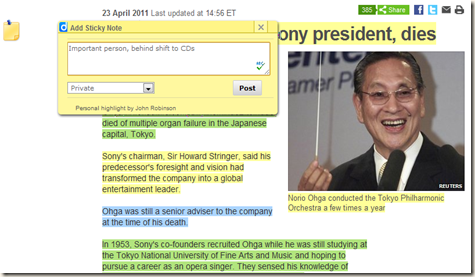
Sticky Note Tool
The Sticky Note Tool allows users to attach digital sticky notes to portions of text in an online article. I use this feature to capture my thoughts about portions of text as I read, or just to attach a reminder about an idea while reading the text. These annotations are also made visible from the user’s Diigo account.

Chrome Diigo Extension Sticky Note Feature
Share Tool
This Chrome Diigo Extension tool allows users to easily share found resources on Twitter, Facebook, Google Buzz, through email, or as annotated link. I find it so easy to share resources on Twitter, Facebook, and in an email using this tool. It auto-shortens long URLs too.

Chrome Diigo Extension Share Tool Interface
Saturday, April 16, 2011
Test Pep Rallies: Good Practice or Waste of Time?
If you go into any elementary, middle, or high school this time of year, you are likely to hear shouting like “Ace that Test” or “Let’s rock that test!” emanating from the Gymnasium. For once though, the shouting is not part of a pep rally to try to pump up an athletic team for an impending contest. It is a pep rally to get students pumped up to take state standardized tests.
After a simple Google Search on term “Test Pep Rallies,” I found 131 current articles describing recent events held by public schools across the country that would be described as “Test Pep Rallies.” For some schools, these rallies are combined with various kinds of incentives and rewards, but for now, I want to focus entirely on Test Pep Rallies. Here are some examples. In Ft. Leavenworth, Kansas, an elementary school held a Test Pep Rally in order to motivate students to take the second phase of state testing. Students cheered as teachers rode around on scooters and walked on balance beams. The sole purpose of this event was to motivate students to do well on the upcoming state test. Then there was the big test pep rally held in Fort Wayne, Indiana by a middle school. In order to further motivate students “to do better on tests” the principal told students that he would shave his head and throw a big party for them if they scored well on their standardized test. A similar event is held in Derry, New Hampshire where students are being motivated to do well on their New England Common Assessment. The principal in this case throws in a big smooch with a pig to get students motivated.
Check out some of these other Test Pep Rallies":
Elementary School in Idaho
Charter School in Louisiana
Elementary School in Florida
Elementary School in Tennessee
All over the country, administrators and teachers are holding “Test Pep Events” obviously with the hope that these events will someone have a positive effect on student achievement scores. But just what do administrators and teachers hope to accomplish with these test pep rallies?
In all the news articles I reviewed that described these “Test Pep Rallies” there were five main reasons given for holding these events:
There is clearly a lack of research to support the practice of having test pep rallies even though I was able to find news articles describing such events as far back as the early 1980s. This lack of research concerning the effects of such practices leaves me with quite a few questions about their use. For example, do they actually have positive effects on the things they’re supposed to affect, like self-esteem, self-confidence, student test-taking stress, or the student’s achievement? When looking for research on effectiveness there is a deafening silence except for anecdotal accounts. If the practice of holding test pep rallies extends as far back as the early 1980s, you would think someone would have investigated the issue.
Of a bigger concern to me is what are some of questions I have about the possible negative effects of holding Test Pep Rallies. Those questions include:
After a simple Google Search on term “Test Pep Rallies,” I found 131 current articles describing recent events held by public schools across the country that would be described as “Test Pep Rallies.” For some schools, these rallies are combined with various kinds of incentives and rewards, but for now, I want to focus entirely on Test Pep Rallies. Here are some examples. In Ft. Leavenworth, Kansas, an elementary school held a Test Pep Rally in order to motivate students to take the second phase of state testing. Students cheered as teachers rode around on scooters and walked on balance beams. The sole purpose of this event was to motivate students to do well on the upcoming state test. Then there was the big test pep rally held in Fort Wayne, Indiana by a middle school. In order to further motivate students “to do better on tests” the principal told students that he would shave his head and throw a big party for them if they scored well on their standardized test. A similar event is held in Derry, New Hampshire where students are being motivated to do well on their New England Common Assessment. The principal in this case throws in a big smooch with a pig to get students motivated.
Check out some of these other Test Pep Rallies":
Elementary School in Idaho
Charter School in Louisiana
Elementary School in Florida
Elementary School in Tennessee
All over the country, administrators and teachers are holding “Test Pep Events” obviously with the hope that these events will someone have a positive effect on student achievement scores. But just what do administrators and teachers hope to accomplish with these test pep rallies?
In all the news articles I reviewed that described these “Test Pep Rallies” there were five main reasons given for holding these events:
- Get students excited about taking the test
- Motivate students to do well on the test
- Help students cope with “pre-test tension”
- Help boost students’ self-confidence going into state testing
- Raise students’ self-esteem before they take the test
There is clearly a lack of research to support the practice of having test pep rallies even though I was able to find news articles describing such events as far back as the early 1980s. This lack of research concerning the effects of such practices leaves me with quite a few questions about their use. For example, do they actually have positive effects on the things they’re supposed to affect, like self-esteem, self-confidence, student test-taking stress, or the student’s achievement? When looking for research on effectiveness there is a deafening silence except for anecdotal accounts. If the practice of holding test pep rallies extends as far back as the early 1980s, you would think someone would have investigated the issue.
Of a bigger concern to me is what are some of questions I have about the possible negative effects of holding Test Pep Rallies. Those questions include:
- How does all this emphasis on the importance of students “passing the test” or “doing well on the test” affect those students who are unsuccessful?
- How does holding “Test Pep Rallies” foster a culture where “teaching to test” is expected and the norm?
- Do these “Test Pep Rallies” even work as advertised? Not that I agree with the “test maniacs,” but do these events even raise test scores?
- What effects does having “Test Pep Rallies” have on longitudinal testing data? For example, how does this figure into those who push value-added models? (Perhaps someone needs to conduct a value-added study of Test Pep Rallies.)
- Do these Test Pep Rallies foster a culture that trivializes learning and makes standardized tests the focus of all learning?
- “Test Pep Rallies” might actually harm students and learning. For example, pumping a student up by telling him he’s going to “pass the test” when he fails, obviously is not a boon to self-confidence. In addition, the emphasis that Test Pep Rallies place on tests could foster bubble-sheet learning rather than learning that focuses on problem solving and creativity.
- “Test Pep Rallies” might also reinforce the “Test-Prep” culture found in many schools today due to No Child Left Behind. In those schools we are confident “getting-ready-for-the-test” takes precedence over everything else. Art and other non-tested courses are tossed out in favor of tested subjects.
- “Test Pep Rallies” might just be a waste of time. Because there’s no research on their effectiveness to do what they’re designed to do, continuing them year after year might be based on hope and wishful thinking rather than solid evidence.
Sunday, April 10, 2011
Politicians Don't Get It: Merit Pay Won't Work
In response to those politicians in Florida and elsewhere who have pushed their merit pay bills through in the face of research that says it won’t work, and also in the face of many experienced educators who tell them the same, I post Daniel Pink’s TED video “The Surprising Science of Motivation.” I suspect it is just as Pink says:
“What worries me as we stand here in the rubble of the economic collapse is that too many organizations are making their decisions, their policies about talent and people based on assumptions that are outdated, unexamined, and rooted in folklore more than science.”The idea of merit pay and pay for performance will not work. It will not improve education, and in the end, we can only hope it does not cause major damage to public education. Perhaps though, that is the ultimate goal any way. With the public education system in shambles due to bad education policy, there is no option but privatize. Then again, maybe this whole push for merit pay is indicative of who and what we truly idolize in this country: we think the answer to all our problems lie in free markets and business. We forget that our current economic mess was caused by that which we idolize.
Sunday, March 27, 2011
Perhaps It’s Time to Rethink Term “Gifted”?

But, what if, genetics is more complicated than that? What if our talents and giftedness are not solely dictated by those magical genes we carry inside us? Shenk’s book tries to provide such an argument by pointing out a new “dynamic model” of genetics called “interactionalism.” In this model of genetics, rather than being blueprints that dictate who or what we become, genes are more like “knobs and switches” that respond to a wide variety of factors both internal and external. According to Shenk, these factors include things like: nutrition, hormones, sensory input, intellectual activity, and even other genes. The old genetics model basically says that genes come first and influence what we are and what we become. The interactionalism model says it all begins with interaction with these internal and external factors which determine how genes express themselves.
This model of genetics is intriguing to me as an educator. Like Shenk, it makes me ask the question, “What if no one is genetically doomed to mediocrity?” Shenk clearly qualifies this model of genetics by saying that it doesn’t necessarily mean that we can become whatever we want to become. We are still limited within both environmental factors and genetics, but he gives us a perfect analogy in his book to describe our genetic differences. He says, “Our genetic differences aren’t straitjackets holding us in place; they are bungee cords waiting to be stretched and stretched.” Perhaps we as educators can consider ourselves these “stretchers of bungee cords” in some fashion. Our job is to find a way to tap into and use what Shenk calls “Positive Environmental Triggers” to pull all we can academically from our students. Shenk gives a list of some of these positive environmental triggers in his book:
- Speaking to children early and often
- Reading early and often
- Nurturance and encouragement
- Setting high expectations
- Embracing failure
- Encouraging what Carol Dweck calls a “growth mindset”
David Shenk’s book and the ideas of genetic interactionalism are definitely something we as educators should ponder. What if our school policy is actually holding back students who could otherwise demonstrate a level of talent or giftedness of which we were not aware? What if there are missed opportunities to “stretch” students beyond the achievement boundaries many have set for them? I think we’ve all known those occasional teachers who seem to miraculously do just that. They get students to do things that no one else has ever been able to do. Just maybe, these teachers actually redefine the word “gifted” by what they do with kids.
Wednesday, March 23, 2011
Textbook Publishers Are Major Obstacle to Adopting E-Books in Education
I was disappointed this morning in watching textbook adoption presentations done by several major publishers. I might as well have been sitting in a textbook presentation from the mid-1990s. My hopes and expectations for seeing cutting edge technological innovation from these companies were dashed to pieces. Somewhere inside I felt a bit sorry for these publishers. I’m not sure but I think I might be witnessing a “Blockbuster Scenario” involving our major textbook publishers in this country. As you know, Blockbuster didn’t see the video streaming train coming, and tried to break into the business way too late. Now they’re sitting on the “Chapter whatever-you-call-it block.” It appears textbook companies are caught in the same trap. They are on the verge of irrelevance, and I ‘m not sure they even know it. During the course of their presentations and during my conversations with their sales reps, I couldn’t help but get the feeling that these guys don’t get it. Here are some assumptions I think they still cling to about textbooks.
- The textbook is the central instructional tool used by teachers in the classroom. Obviously, there are some classrooms where that is the case. I hate to disappoint them, but that isn’t true in the vast majority of classrooms I visit, and my last few years in the classroom, there were entire weeks at a time when we did not use textbooks. Textbooks for many teachers are supplemental tools, not the main act anymore. I don’t hear teachers saying things like, “Get our your books and turn to page 433 very much any more.” More and more teachers are turning to the Web and technology for instruction. Textbook companies are still trying to sell educators books that were designed to be the main act of teaching, and a lot of teachers just don’t use those books that way any more.
- Students and teachers don’t care about the size of textbooks. One textbook I reviewed yesterday had 1500 pages and had to weigh close to 10 pounds. Students very much care about the size of textbooks. If they have a teacher who assigns homework, they have to lug that massive tome homeward at the end of the day. Talk about fostering resentment! Creating a literature textbook of massive size might have lots of resources in it, but it will not make students love literature any more. I really don’t think teachers and students are interested in getting more poundage for their money. Textbook publishers need to consider their customers which does include the students who have to put their product in their bookbags. Sometimes even the best teacher would have a problem convincing a student that carrying around a 10 pound textbook is their best interest.
- Textbook publishers think 21st century educators are willing to pay full textbook price to get e-textbooks. And, as an addendum to this, they also believe progressive educators will want to have to buy their physical product to get their e-texts. Yesterday, I was told repeatedly by each publisher that I had to purchase their physical textbook to get access to their e-text. One company did offer to strike a deal though. I could buy their e-text alone, but I had to pair it with their textbook software in order to get their e-books, and the price of their e-book was the same. Textbook publishers and their marketers are caught in the same limbo that caused Blockbuster’s demise. They really don’t see that they are going to have to find a way to provide their customers with the products they want. I am interested in purchasing e-texts. I don’t want physical books to go with them. I don’t want some big software package to go with them. I don’t want to pay as much for an e-text because it can’t cost as much to create and distribute an e-text. My advice to them is: “If you can’t provide me with the e-book I want, I will find some way to get what I need and want.”
- Textbook publishers are following the state and federal policymakers when making marketing decisions and not classroom teachers and educators in general. For example, over and over, the sales pitch of the day during the presentations yesterday was, “Our book aligns with the new common core standards.” One textbook publisher happily and gleefully pointed out that they were the only textbook company to publish the relevant common core on the beginning page of each literary work in their literature book. Who cares! I can’t speak for all English teachers, but for me what was most important about the text I used was the actual literary works included, not what was written in the margins.
- Language ArtsTextbook publishers still are publishing the same literary works in texts that have been there for last 100 years. For example, I opened a ninth grade textbook, and the first three short stories I encountered were three that I used when I began teaching 21 years ago. I’ll concede that they are generally considered classics, but doesn’t anyone write classics any more? Also, let’s face it, in the interest of engaging students, could we not, just once in a while include something different? It seems that there are short stories, poems, and plays that have been declared by the muses to be fodder for textbooks for all eternity, and textbook publishers never stray outside that list.
- Textbook companies still believe that questions and activities at the end of a story or chapter are useful. Again, I can’t speak for all language arts teachers, but I never used the questions at the end of the story, poem or play. In my experience, students hate those questions, and they cause more of them to hate literature than having a 10 pound book to carry around. Also, most of the time, the activities provided at the end of the selections were not useful of engaging for the students I taught. I had my own activities to use with the selections I was reading, so those things were not needed. Now some would argue that this feature is useful for new teachers. I would argue they were not. There’s nothing more useful than having a mentor teacher willing to open their toolbox to share their instructional activities. Just give me a textbook that has quality, highly engaging literature. Keep all that other stuff.
I think it is clear that textbook publishers are caught in a time warp. They aren’t paying attention to their customers. They still count on the fact that states have this pile of money that can only be spent on physical textbooks, so perhaps they figure teachers will choose one of their products because they have to. Ultimately, the products they sell are little different from, at least the ones I used when I began teaching 21 years ago. After my experience watching their textbook presentations yesterday, I think they’re in a world of trouble. They had better begin re-engineering their products, or they’ll go the same way as Blockbuster.
Technorati Tags: instructional technology,educational leadership,e-books,textbooks,publishing industry
Subscribe to:
Posts (Atom)