Showing posts with label leader communication skills. Show all posts

Monday, June 30, 2014

Pause and Delete: Sometimes Our Best Response to Those Passionate Emails We Receive

“Pause before sending an email. What do I want to see come out of this communication? The other party to feel diminished or encouraged?” Sharon Salzberg, Real Happiness at Work: Meditations for Accomplishment, Achievement, and Peace

Email has made it quite easy to speak your mind. How many of us are guilty of pounding out a scathing response to an email that we received from someone else who wrote from a moment of passion? Chances are, unless you’ve been asleep for the first decade of the 21st century, you have had your own experiences of composing and sending an email that did little to be helpful and much to be hurtful or detrimental to an already emotional situation. There’s something about email that seems to make it OK to speak to other people in ways that we would dare not speak to them in person.

This tendency to respond out of passion is all the more reason to “Pause” before sending that email when we find ourselves ruled by passion. A simple test I follow is this:

I ask myself: Will this email response be useful? And, as Sharon Salzberg indicates, “What do I want to see come out of this communication?” If the answer is harm to another person, then perhaps the delete button is the best option. If my email response will bring about harm to another, even in the spirit of revenge, then is it really expedient to send that message?

We don’t have to be discourteous and thoughtless with our messages. In fact, in our times, there’s just too much polarization and hate to go around already. Why would we choose to add more simply because it satisfies our own sense of revenge?

Today, don’t be afraid to “Pause” before sending that email-of-vengence.” If our message is harmful to others, no good can come from it. The delete button is sometimes the best option.

Thursday, February 7, 2013

Knowing When Not to Say Anything: 4 Times Silence Is Better Than Words

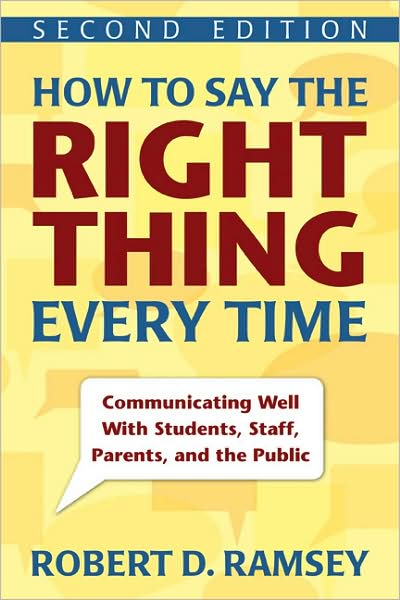
"While embracing the value of straight talk, school personnel also need to realize often there is one communication tool that is even more powerful and effective: no talk at all," writes Robert D. Ramsey in his book How to Say the Right Thing Every Time: Communicating Well with Students, Staff, Parents, and the Public. Because we are all teachers, we always seem to fall into the trap of thinking that we are obligated to make a point, teach a lesson, or "impart 'wisdom." The problem is, as Ramsey clearly points out, such thinking ignores that communication is 2-way. Sometimes, "silence does speak louder than words" and knowing when to just be silent is a leadership and teaching skill like any other.

But when should we resist this temptation to speak with our words of wisdom? The art of "not speaking" is an important part of communicating. Ramsey offers us some advice on when not saying anything is better than speaking.
  • You have already said too much. It's not hard to know when you've reached this point. This is the "open-mouth-insert-foot" point of communicating. When you have said more than you should have already, usually trying to make it better by saying more makes things messier. Being able to recognize that you can't say anything else that will help the situation means telling the teacher inside that this is one time to teach means to be silent.
  • Someone comes to you to vent. We've all taken these phone calls and had these conversations. A parent calls us to vent their frustrations, even though they aren't really just upset about a decision we have made. Or, a teacher is frustrated with how things are going in their fourth period class. Deep down, they know you don't have the answers, and they know you did not hand pick those students to terrorize them for a semester. They just want to vent. Being able to recognize when someone comes to you in order to vent means telling the teacher inside that his wisdom will probably not help in this situation.
  • You are mad. This is common sense. Things said in anger are often rash and counterproductive, period. Just like you shouldn't respond to an emotionally charged email immediately, you should recognize when you can't be objective and get beyond your own feelings. Being able to recognize when your feelings are an obstacle to clear communication means telling the teacher that now is not the time to respond.
  • Finally, you don't know what to say. There is absolutely nothing wrong with being silent, especially when we don't know what to say or how to respond. Perhaps it might be beneficial to just say, "I don't know what to say" if you just can't stand the silence. Trying to fill space with inane words and language doesn't help anyone. Being able to recognize when you don't know what to say means telling the teacher inside of you, silence is OK, or just admitting that you don't know what to say is acceptable.
There is truly power in silence. While the teacher in us feels like we should always be ready to impart wisdom, the truth is, the best wisdom imparted is sometimes done so by not saying anything.

NOTE: Robert D. Ramsey's book How to Say the Right Thing Every Time: Communicating Well with Students, Staff, Parents, and the Public is full of advice and lists of making the most of communication with everyone. It is an excellent addition to your administrator's library.

Cover Image