Showing posts with label authentic learning. Show all posts

Wednesday, May 28, 2014

Turning Your Classrooms from Places to Control Students to Places to Engage Them in Learning

“For the first time in the history of education, the teacher, the student, and the content do not need to be in the same place at the same time.” Ian Jukes, Windows on the Future

NewImage

How we handle the details of designing our “learning spaces” ultimately determines what happens in our classrooms. As Jukes points out, for the first time in history students and teachers do not even have to be in the same place when learning. Also, the content is no longer confined to textbooks. Still, our schools’ classrooms are designed for “imparting knowledge” not engaging in authentic learning. I would bet if you look at any recent plan drawn up for a new school, the spaces are still designed for traditional factory model learning. The classrooms are arranged like so many pods with desks sitting in rows with a teacher desk placed at the front of the room with a whiteboard located behind. What many still do not quite understand is  a simple principle of classroom design: How you plan the learning space ultimately determines the kinds of learning that happens in that space. Even the furniture selections can impact the learning that happens.

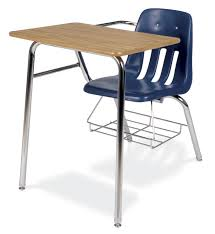
Take the student desk as an example (like the illustration above). These desks are still everywhere in our schools. When new schools are built, hundreds of these are ordered and then placed in neat rows in classrooms. But this particular desk is problematic if we are looking to create learning spaces where students collaborate and engage in active learning. These desks are designed to be placed in rows and to actually restrict the movement of the student sitting in it. Have you ever complained about how hard it is to move and get out of these things? But in a factory era school, student movement is discouraged and what better way to do it than by designing a desk that minimizes the movement of students? These desks are perhaps a symbol of what’s amiss about so-called 21st century education today. We still think of learning spaces as ways to control students rather than ways to engage them in real learning.

I have no way of knowing whether those who designed the first student desks in this manner really had the goal of making a desk that restricted movement, but the fact that so many of these still exist in our classrooms is symptomatic of a greater problem: We just can’t let go of the idea that schools are factories whose job is to churn out students who have been declared educated through testing and credentialing. “Get’em through the system like widgets and declare them graduated and educated if they make through the hurdles and tests.” In our classroom learning spaces we still buy furniture whose purposes is to control and attempt to make learning fit into neat orderly boxes, when those of us who’ve been teachers for some time know real learning is messy and not always subject to the controls we place on it. We keep arranging our schools’ classrooms for teacher-directed instruction instead of designing them for student-directed and inquiry learning which we know is how most of our students want to learn. In a word, for all our talk, we are trying to fit 21st century learning into classrooms designed for factory-model education systems.

Obviously, my point is obviously not to get you to throw out all the student desks in your buildings. But, the question is, how can we re-envision our learning spaces to make authentic, engaging learning happen for our students? We can begin by looking at our current classrooms and see how we can transform them from places to control to places to explore and engage learning. This doesn’t really cost us very much either.

Monday, September 16, 2013

Who Am I Projects? Getting Students Started with Project-Based Learning

Giving students starter projects at the beginning of the school year is vital to make sure they learn the mechanics of project-based learning, collaboration, and engagement. It is the project scaffold that makes future project-based learning instruction more fruitful. This morning, during class visits, one of our world history classes was engaged in creating "Who Am I?" projects, which are designed to frontload these PBL skills.

The "Who Am I?" project involves students engaging in finding answers to four essential questions:
  • Who am I?
  • Where am I going?
  • How will I get there? 
  • What do I believe?
These questions are ideal in many respects. For example, they tap into ninth graders interest in themselves, and to place these questions in the context of a project makes this first venture into PBL especially relevant. In addition to exploring these questions, students were also asked to create a presentation as their product for the "Who Am I?" project. To further scaffold the assignment, they were provided an outline to follow regarding how they should structure their presentations. Students were also asked to use PowerPoint to create these presentations to allow a deliberate focus, not on learning software, but on working through the PBL process. Some students who asked to use other presentation tools were not prohibited from doing so.

Students were also provided with a rubric as well. They were to be evaluated in these five areas:

  • Product Content
  • Product Organization and Clarity
  • Presentation/Speaking
  • Presentation/Eye Contact and Physical Presence
  • Product and Presentation Preparedness
The "Who Am I?" project is an excellent starter project for freshmen high school students for several reasons.


1. In my experience, freshmen love engaging in assignments that allow them to talk about themselves. It is developmentally appropriate to tap into this natural fascination with themselves and their own lives.

2. This project gives students a scaffold on which to learn the skills of putting together a project and giving effective presentations. Students aren't confronted with all the complexities of PBL all at one time.

3. Students use familiar technological tools, instead of attempting to engage in project creation and learning new technologies with their first project.

4. Students are provided with a non-threatening, less content-connected project for their first one so that they can learn the mechanics of PBL first, before engaging content as well.

Structuring students' first PBL experiences to minimize threats and insecurity is important. Deliberately teaching PBL processes up front is a must if future projects are going to be successful. It is equally important for each teacher to teach students what project-based learning means in their individual classrooms as well.

Thursday, August 8, 2013

Is Your School or District Ready for PBL? 12 Deep Changes Needed for Implementation

"Schools must embrace a new pedagogy today that will engage 21st century students and enable them to acquire and master 21st century skills. Once they embrace the necessary changes in pedagogy, they realize the need for change in the physical learning environment." Bob Pearlman, "Designing New Learning Environments to Support 21st Century Skills"
In response to the Common Core State Standards many school districts and schools are discussing moving toward 21st century models of instruction like Project-Based Learning and other forms inquiry-based teaching and learning. The problem is, if school leaders do not ask the right questions and do not commit to deep changes in how their schools currently look and operate, attempts to move to a transformative pedagogy like PBL is going to be for naught. Project-Based Learning is not a teaching strategy that can be effectively "bolted" on current or existing school structures and operations. For it to be successful, there needs to be some fundamental deep changes in both thinking and in the way schools carry out the business of teaching and learning.

What then, are those deep, underlying changes that need to be considered to move a school or district to an effective project-based learning model? While these are mostly based on my personal observation and reading, Project-Based Learning is a type of "personalized learning" which means it is at its core in direct conflict with the standardized, one-size-fits-all model of schooling we call the :factory model of education." Simply put, you can't successfully implement Project-Based Learning by bolting it on top of a factory model.

Deep Changes Needed for Effective PBL Implementation

1. There has to be a fundamental and deep change regarding what teaching and learning looks like. At the school level this means that teaching can no longer be seen as "imparting knowledge" or "subjecting students to learning treatments." Learning is no longer viewed as something to which students have done to them. Instead, teaching is more about coaching, guiding, and personalizing learning experiences. Learning is more student-centered and student directed. Students have more choice and freedom in what kinds of content they explore and in how they demonstrate their learning. Everyone, from the superintendent down to the classroom teacher assistant must see teaching and learning differently.

2. There must be a deep and fundamental change in the role of the teacher. Teachers in PBL schools do not see themselves as "imparters of knowledge." They take on the role of "facilitators" of learning. They basically have to turn over most of the work of instruction and learning to students. They give up the role of chief information officer in their subject areas. There is little room for "professors" in the PBL classroom. Becoming a facilitator and guide means letting go of the image of the teacher as expert.

3. The way classrooms are designed and laid out must be reconsidered. Classrooms with desks neatly arranged in rows with a teacher desk at the front are not functional in PBL classrooms. Classrooms laid out in this manner communicate clearly who's in control of the learning. It may be efficient for factory-model learning processes, but the PBL classroom requires flexibility. Students seated at tables for collaboration purposes are a must. Free aisles for movement as students move about the room are necessary. Ample technology needs to be available as well. Move the computers out of computer labs and into the hands of students and in the classrooms. Furniture that can moved and arranged easily is a must in a PBL classroom. Spaces devoted for student meetings and conferences as well as independent work areas are needed. Rethinking how space is used in a PBL school is a must.

4. The concept of using predominately "seatwork" must be abandoned. PBL requires students to move about the entire campus and beyond. Students need to be able to go to the school courtyard to shoot scenes for a video. They need to be able to walk down to the mayor's office in town to interview her about an issue they are researching. They need to be able to get in their car and drive to the local history museum to view an exhibit. Seatwork, by its nature, is designed to keep students sitting in their seats quietly. As Ron Nash puts it, we need give students "feetwork" not "seatwork" in our PBL classrooms. Learning in the PBL classroom is not a spectator sport.

5. The whole idea behind "seat time" or having distinctive "blocks of time per subject" must be modified. The old equation 1 hour = adequate learning or 2 hours = even more adequate learning needs to be abandoned. PBL sets the conventional and long-held wisdom that learning happens only in classrooms on its head. Learning happens where students are and what students are engaged in. Classrooms are no longer the centers of learning in our students' lives. The idea that students must sit in biology for 90 minutes every single day to learn is no longer true, if it was ever true. The idea of seat time simply betrays the thinking that learning is something students must be subjected to rather than something they engage in. PBL is about engaging in learning personally, not sitting in a desk, having  it imparted to you in prescribed, discrete time period every day.

6. School operations and procedures and rules must be modified. To put it simply, PBL implementation plays havoc on the classical orderliness of a school. When students are engaged in projects, they are potentially everywhere on campus. They may be off campus shooting video of an interview with a local CEO, or they may be in the hallways rehearsing a skit or play they have written. Rules like students must remain in their seats until the bell rings are ridiculous in PBL classrooms. Rules such as students can't leave campus during the school day are obstacles to powerful project-based learning. The ways schools operate under PBL must be modified and the rules must be examined and modified to allow for the often messy and chaotic nature of learning under the PBL model.

7. Efforts must be made to demolish traditional boundaries of subjects and grade levels. In high school this means the death of organization by departments. PBL by subjects and by departments falsely compartmentalizes knowledge. In the real world, when workers solve problems, they work interdisciplinary. Solving a town water problem is never just a science problem; it is also a civics problem, a communications problem, and most likely a math problem. Schools adopting PBL must be willing to dissolve departmental and subject boundaries. Traditional high school teachers must give up their turfs and kingdoms and work collaboratively across subject areas. In elementary schools, the idea of devoting time to subjects needs to be abandoned in order to focus on projects that have no subject-area boundaries. In PBL school knowledge is not falsely compartmentalized by subject area.

8. The idea of having one set schedule for all students needs to be reconsidered. Schedules with ringing bells are fossils from the factory model of education. Yes, they do efficiently move students about the building during the school day, but too often they sacrifice effectiveness for efficiency. The whole idea of a discrete schedule for all students all the time can hamper or restrict PBL implementation. Students must be able to leave campus to visit museums, places of business, and governmental centers. Schedules most be modified to allow for learning to extend beyond the classroom walls. To do this, the whole idea of static schedules needs to be re-examined.

9. Administrators must be more tolerant and willing to encourage much risk-taking. PBL requires teachers to be willing to give up a great deal of control over student learning. School leaders must be willing to allow teachers to experiment and explore too. Administrators who try to exert too much control over the immediate environment of the school stifle true exploration. It comes down to the question of whether the desire for strict orderliness outweighs the value of the learning experience. For PBL to thrive, school leaders must be willing to let go of their desire to control everything too. Mistakes are causes for learning, not something to be avoided. Administrators in PBL schools must change their desire to control what is essentially a very messy learning model, yet still maintain safety and operational effectiveness.

10. Teachers must move to interdisciplinary, collaborative learning communities. PBL requires teachers working together. Planning projects effectively forces teachers to work together. They must be willing to use processes like "critical friends" to obtain feedback on their project plans. In a PBL school, teachers must be willing to give up ownership of both time and space. Students in their classes may need to go down the hall and work in a lab or down the street to city hall. Teachers may also need to allow students in their classes throughout the day. Implementing PBL requires collaboration among all staff, including those in the central office.

11. Professional development in PBL is not a one-time, sit-and-get endeavor. It must be embedded, consistent, and perpetual. I fear those talking about implementing PBL are thinking about subjecting entire schools or even their entire districts to PBL training and then calling it a day. Or, even worse, they subject all teachers to the training, provide administrators with "gotcha" lists to then go out to the classrooms and force teachers to engage in PBL. To truly move to PBL requires buy-in. It takes time and lots of support. Teachers must be provided with all the materials and resources needed to effectively implement. School leaders must be willing to provide ample time for common planning during the school day and school year. Professional development must involve a  long-term commitment to provide constant and ongoing training during an implementation period and beyond.

12. Schools and school districts must be flexible. Public schools in the United States in my experience aren't known for being flexible institutions. They demand conformity, not creativity. They demand adherence to policies and rules, often at the very expense of the teaching and learning. Sure, schools as institutions need policies and rules, but these should never exist for their own sake. They need to be flexible to meet the fast-changing environment that is fostered when schools truly move to a 21st century learning model like PBL. Forcing PBL instructional models on inflexible institutions will not work.

Those schools and school districts thinking they can just "bolt" Project-Based Learning onto their existing structures and existing operations are doomed to making the same mistake those who advocated and pushed for the "Open Schools" concept in the 1960s. They built enormous buildings with classrooms without walls and simply put teachers, teaching the way they always have into these spaces and told them to get at it. Naturally it failed. They did not seek fundamental changes to how teachers engaged in teaching and students engaged in learning. They did not change their own deep understandings of how learning should happen in those spaces. If schools are going to successfully implement PBL, they must be willing to engage in a deep rethinking about education and how it is carried out.
Thursday, June 20, 2013

Why Wouldn’t We Let Students Blog? Reasons to Get Students Blogging

One of the greatest battles I fought as an English teacher was the in-authenticity of my students’ writing. English teachers know exactly what I mean. After slogging through a stack of literary essays, that only English teachers read, your eyes begin to glaze, and if you are really honest with yourself, you realize, “NO ONE READS THIS STUFF! WHY DO I SUBJECT MYSELF TO IT?” Of course, we also know the English teacher, scholarly argument: “They need to know how to do this when they get to college, so it is a worthwhile activity.”

But really, do college English instructors still make students engage in kinds of writing that they never do again once they leave English 101 or 102? Sure, the “literary essay” serves some purpose. It's purpose is limited, however, and it is important to remember that it is hardly a truly authentic piece of writing, except maybe for literary scholars. Yes, it can force students to think critically about a literary work, but is it the best way to get students to engage that work critically? There are probably more engaging ways to get students to do that kind of thinking. That’s perhaps where blogging is different and could help. It has the potential to allow students to engage in authentic writing for authentic audiences.

I have written about its potential before, but in a conversation the other day, I became aware that there are still school leaders who do not allow students to engage in blogging. The reason why I asked the question in the title, “Why wouldn't we let students blog?” is because school leaders still  fight to keep blogging away from their students, perhaps out of fear that students might reveal something very private about themselves or make connections with unseemly characters lurking in cyberspace. But cyberspace monsters aside, there are absolutely good reasons to allow students, especially high school students, to use blogging as a way to engage in authentic writing with authentic audiences. In our quest for getting students to do authentic writing, we have at our disposal one of the best ways to do that with blogging. Here’s some good reasons for getting students blogging today:
  • Blogging is an authentic publishing platform. As a former classroom teacher, it was a struggle to find places where my students could authentically publish their work. I tried copying and sharing, posting on bulletin boards and in the hallways, but while that was publishing, it was still not authentic. Students knew it and so did I. It was too superficial. Besides, that kind of publishing usually severely limited students to verbal media, which brings me to my second reason to get students blogging.
  • Blogging allows for publishing in multiple forms of media. In old days, my students mostly just communicated their ideas through words, sentences, and paragraphs. Now, with blogs, students can use video, photos, graphics, to communicate their ideas too. Blogging allows students to engage audiences using most of the media tools available, which also allows them to struggle with the authentic question: "Which media best communicates the idea or message I am trying to send?" You just can't get much more authentic than that.
  • Blogging gives students the potential to engage authentic audiences. To me this is blogging’s greatest strength. You post your ideas for the world to see, and if your ideas win the contest for attention, people read and respond. That’s gratifying feedback. Students struggling to be heard on the web is about as authentic as a writing and communication experience can get.
  • Blogging is easy. Chances are, your students are already doing it. If they aren't, the blogging platforms available are easier to operate than word processing software. The more difficult part of blogging is trying to write engaging content that attracts readers. Also sufficiently promoting the material written is important too. Once again, these are two authentic things writers do.
Perhaps one of the best reasons for getting students to engage in blogging is best illustrated by one of my own recent, personal blogging experiences. In my post on “Data-Driven Decision Making Usually Means Test-Score Driven Decision Making” I made a serious error, that I am a bit reluctant to admit. But, I see it as one of the most powerful lessons blogging can teach. In that post, I used the word “quantitative” instead of “qualitative." What made the error even more serious, was that the use of the correct word between these two choices was essential to my entire argument. I messed up and then some! What happened that demonstrates the power of blogging occurred when a reader emailed me and politely asked about my error. It was then I went back to my post, and sure enough, I used the wrong word. I quickly changed the error, and emailed a big thanks to that reader.

My point about this blogging experience is simple: I made a crucial error in my writing that affected my entire argument. Never mind the embarrassment and never mind the fact that I probably destroyed my entire argument by choosing the wrong word. The real power of learning through blogging lies in the fact that these kinds of authentic experiences have the power to teach students real writing and communication. What better way to learn about the importance of choosing the right word or words as well as proofreading and revising carefully? I should have known better obviously. I have been blogging for some time. I have written more academic papers than I can remember. Still, I failed to edit and revise thoroughly enough, even though I always review, edit and revise a post multiple times before clicking the publish button. This is authentic writing experience, and our students need it too.

Monday, May 20, 2013

Which Model of Project-Based Learning Is Needed in 21st Century Schools?

“PBL has been practiced in various ways in education and has become increasingly common with the advent of of digital technologies in recent years.” Yong Zhao, World Class Learners: Educating Creative and Entrepreneurial Students
Project-Based Learning (PBL)  is being touted as the 21st century answer to how we should be educating students and the perfect delivery-system for the Common Core State Standards. While those reasons for implementing PBL are legitimate, there are other reasons for implementing PBL as well. First of all, it has the potential to be a more engaging learning and teaching strategy. Secondly, it may more accurately mirror the world of work by engaging students in problem-solving. Thirdly, it can engage students in using technology to create and innovate. While these are additional reasons to implement PBL, we also need to be clearer regarding what we mean by PBL. There are multiple versions of PBL and those versions are not all equally effective in addressing these same reasons.

In his book World Class Learners: Educating Creative and Entrepreneurial Students, Yong Zhao describes three different iterations of PBL, each with its own features and desired outcomes. He specifically advocates for the third model, Entrepreneurial Model of PBL, in order to educate students to effectively tackle the problems we face in the 21st century, but his PBL model framework is an interesting way to help us think about what we mean by PBL and what we want to accomplish with its implementation. Here’s Zhao’s three models:

Academic Model of PBL
  • Goal or intention is to teach prescribed content and skills.
  • This prescribed content and these skills drive the project.
  • The resulting products are byproducts of learning and not considered as important as the content/skills learned.
  • Products are not really meant for authentic consumption.
  • Effectiveness of this model of PBL is assessed by how well students master the content and prescribed skills as identified on achievement tests.
  • Teacher controls the content, what is taught, how projects are created and how projects are evaluated.
Mixed Model of PBL
  • This model values the artifacts---the products students create, but also values prescribed content.
  • End products created by students are expected to be of high quality, and are sometimes created for consumers outside the school.
  • Mandated content and standards aren't ignored, but they are not the starting points for projects.Content and skills are not allowed to define, constrain, or guide the projects.
  • To ensure content and skills are taught, teachers are in control of the process: teachers may ask for input but they decide how the project is carried out.
  • Students have varying degrees of freedom within the prescribed project.
  • Students may engage in peer review or evaluation of projects, but evaluation is largely at teacher activity.
  • Focus is less on transmitting knowledge and more about learning real-world skills.
Entrepreneurial Model of PBL
  • Aim is cultivate entrepreneurial spirit and skills.
  • Places more emphasis on artifacts, the products, than either of the other two models.
  • Products must be of high-quality and must appeal to external consumers. Products must meet an authentic need of a customer.
  • Students are in more control of their products. They propose and initiate the product proposal process.
  • They must sell the product to the teacher and get the teacher to approve the product.
  • Students develop a business plan: documentation and analysis of target audience, feasibility studies, and marketing plan.
  • Teacher takes on the role of “venture capitalist,” consultant, motivator, and facilitator.
  • Projects can be individual or collaborative.
  • Time for students to work is divided into large chunks. Traditional schedule and calendar may not suffice.
  • Focus is on the product, not the process or skills necessarily.
  • Product-oriented learning.

It's clear by looking at Zhao’s three models of PBL, that the first two models are about teaching the prescribed curriculum, but only using PBL as the conduit for that teaching. The last model, the Entrepreneurial Model, is designed to foster an entrepreneurial mindset and skill set which is what Zhao’s book advocates and states is needed in the 21st century.

Whether you see Zhao’s “Entrepreneurial Model of PBL” or product-oriented learning as being feasible or not, it does offer some interesting ideas to ponder. As Zhao points out, “Entrepreneurship is about inventing a solution to an existing problem or creating a product or service to meet a need.” And if what we really need are creative and inventive solutions to the problems staring us in the face as 21st century citizens, then there’s certainly a great deal merit in this Entrepreneurial model of PBL.

Saturday, August 11, 2012

5 Things Teachers (And Administrators) Can Do to Make Learning Real in Their Classrooms

To paraphrase Marc Prensky from his collection of essays From Digital Natives to Digital Wisdom: Hopeful Essays for 21st Century Learning: “The easiest, executable solution to our education problems today “is to change what goes on in our classrooms.” We need to move from teacher-centered and teacher dominated learning models to more personal, student-centered learning models. In the process, we will do what Prensky calls “Making Education Real” for our students.

Enough of the rhetoric and cheap talk. What does it really mean to make education and learning real in the classroom? In his essay, Prensky offers “5 Things Teachers Can Do at the Beginning of the Year to Make Education Real for Their Students.” I am going to modify that just a bit a here to capture what I think are the “5 Things Teachers Can Do to Make Learning Real in Their Classrooms.”
  • Get to know your students. And this does not mean their proficiency levels and past test scores. That information is important, but if you want to make learning real for your students in your classroom, you better connect with them. Connecting means learning about what they are passionate about. It means learning who they are as persons. It means connecting with them on a personal level. For learning to be real in your classroom, you have to see students as real people, with real passionate interests and needs. No room for standardization here.
  • Reduce the amount of time you spend “telling” in your classroom and engage students in more “partnering activities” that allow students to pursue their own passions. Granted, it is a challenge when there are “Adopted Standards” waiting to be tested, but so many students don’t learn at all, much less deeply with lecture and “sit-n-get” modes of instruction. As Prensky notes, “Capitalize on students’ 21st century abilities to learn on their own.” Give them opportunities to engage in the kind of learning they are wired to do instead of forcing them to learn in an incompatible manner.
  • Facilitate learning by guiding students through their learning. Teachers can help students focus on what’s important and what’s next. They can help them make the most of 21st century learning tools to engage in content and skills. This means stepping out from the front of the classroom and standing beside or sitting with students as they learn. It means letting goal of being the center of the classroom.
  • Foster global connections with peers and experts. Teachers should assist students in connecting with other students globally. They should help students connect with experts that can help them learn. In effect, teachers should help students create their own Professional Learning Networks (PLNs). Then, they should help students care for and grow that network according to their learning needs.
  • Motivate students by allowing them to use their 21st century devices in their learning. This means setting aside the impulse to block the use of cell phones in the classroom. This means providing students with wireless access in the school building in the form of Bring Your Own Device (BYOD) initiatives and 1:1 Technology initiatives. It means engaging students in the use of social media and other technologies rather than blocking them on school networks. We can make learning real by simply allowing students to use the devices of learning they use outside our school walls.
If we really want to change education and learning for our students, let’s change what is happening in classrooms, and our buildings. Let’s make education real for our students by moving from “Telling” classrooms to “Partnering” classrooms that enable students to engage in learning.