Showing posts with label active learning. Show all posts

Wednesday, May 28, 2014

Turning Your Classrooms from Places to Control Students to Places to Engage Them in Learning

“For the first time in the history of education, the teacher, the student, and the content do not need to be in the same place at the same time.” Ian Jukes, Windows on the Future
NewImage

How we handle the details of designing our “learning spaces” ultimately determines what happens in our classrooms. As Jukes points out, for the first time in history students and teachers do not even have to be in the same place when learning. Also, the content is no longer confined to textbooks. Still, our schools’ classrooms are designed for “imparting knowledge” not engaging in authentic learning. I would bet if you look at any recent plan drawn up for a new school, the spaces are still designed for traditional factory model learning. The classrooms are arranged like so many pods with desks sitting in rows with a teacher desk placed at the front of the room with a whiteboard located behind. What many still do not quite understand is  a simple principle of classroom design: How you plan the learning space ultimately determines the kinds of learning that happens in that space. Even the furniture selections can impact the learning that happens.

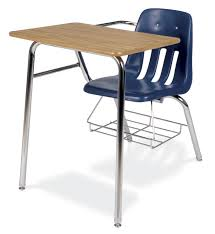
Take the student desk as an example (like the illustration above). These desks are still everywhere in our schools. When new schools are built, hundreds of these are ordered and then placed in neat rows in classrooms. But this particular desk is problematic if we are looking to create learning spaces where students collaborate and engage in active learning. These desks are designed to be placed in rows and to actually restrict the movement of the student sitting in it. Have you ever complained about how hard it is to move and get out of these things? But in a factory era school, student movement is discouraged and what better way to do it than by designing a desk that minimizes the movement of students? These desks are perhaps a symbol of what’s amiss about so-called 21st century education today. We still think of learning spaces as ways to control students rather than ways to engage them in real learning.

I have no way of knowing whether those who designed the first student desks in this manner really had the goal of making a desk that restricted movement, but the fact that so many of these still exist in our classrooms is symptomatic of a greater problem: We just can’t let go of the idea that schools are factories whose job is to churn out students who have been declared educated through testing and credentialing. “Get’em through the system like widgets and declare them graduated and educated if they make through the hurdles and tests.” In our classroom learning spaces we still buy furniture whose purposes is to control and attempt to make learning fit into neat orderly boxes, when those of us who’ve been teachers for some time know real learning is messy and not always subject to the controls we place on it. We keep arranging our schools’ classrooms for teacher-directed instruction instead of designing them for student-directed and inquiry learning which we know is how most of our students want to learn. In a word, for all our talk, we are trying to fit 21st century learning into classrooms designed for factory-model education systems.

Obviously, my point is obviously not to get you to throw out all the student desks in your buildings. But, the question is, how can we re-envision our learning spaces to make authentic, engaging learning happen for our students? We can begin by looking at our current classrooms and see how we can transform them from places to control to places to explore and engage learning. This doesn’t really cost us very much either.

Tuesday, August 6, 2013

6 Practices for Creating a 21st Century Engaging Classroom

“Teachers who are willing to experiment and take risks on behalf of kids are in a much better position, regardless of their age, to meet their students where they are, and my experience is that students appreciate the effort.” Ron Nash, From Seatwork to Feetwork: Engaging Students in Their Own Learning
A new school year is upon us, and the decisions we are making now as educational leaders and classroom teachers will determine whether our students are engaged learners, or are passive learners. In other words, our decisions now will determine whether education is something we do to our students or whether education is something into which we actively engage them. The time for "Planning for Student Engagement" is now.

As you and your teachers ponder questions like:

  •  How do I arrange my classroom or classrooms this year?
  • What kinds of technologies will I use? 
  • What materials will I use?
here are some practices for moving your students from active to passive learning mode in the 2013-2014 school-year.

1. Rearrange your classroom to facilitate collaboration and cooperation, not conformity and standardized learning. How a classroom is arranged communicates to students what they are expected to do. It screams loudly to them if desks are arranged in rows in front of teacher’s desk, “I am the teacher, the imparter of all knowledge and wisdom, and you are my students, the receptacles of all my knowledge.” Take the time before school starts to really ponder your classroom arrangement. If you want student interaction and student-driven learning, you may want to move your teacher desk out into the hall (Just kidding. I know the fire marshal would have a fit). With your classroom arrangement, purposefully create places for collaboration and talk.

2. Change your mindset from “curriculum or content coverage” to a mindset that engages students in in-depth, relevant learning. In a test-driven school culture, it is easier to “cover content” rather than really examine what you are asking students to do and have them actively engage that content. Covering content means just that, and fosters a teaching attitude that says, "Well, I taught it; it's the kids responsibility to learn it." The trouble with that thinking is clear: no, you didn't really teach it. You covered it. Engaging students in content deeply means teaching that asks students to apply that content in some deep and meaningful way. The old factory maxim that puts students in the role of recipients of knowledge rarely is engaging anymore. Take on the mindset of engaging students in learning not covering content standards.

3. Take instructional risks this year. Don’t sacrifice creativity and innovation to obtain orderliness and conformity. Instructional risks, as Ron Nash aptly points out, are really appreciated by students. They are excited when teachers try new ways of teaching and learning, and teachers who try new ways of instruction are excited too. Recharge your classroom and your students by trying instructional methodology and pedagogy you haven’t done before. It will re-energize your teaching and your classrooms.

4. Accept that real student engagement and student learning is most often messy and chaotic. Places where students are actually engage in learning are often noisy places. At first glance, these chaotic and messy classrooms and schools don’t appear to foster true learning, especially if you view them through the lens of 20th century, factory-model education system. Laughter and loud talking are not necessarily a sign of off task behavior. Students who are engaged make a lot of noise. Don’t dampen their excitement by insisting on silence or sitting in seats. Let the messiness of true student engagement begin on the first day. Embrace the chaos and messy nature of student engagement.

5. Choose your tech tools wisely. Choose the tools that get students engaged in the learning you want them to engage in. Using technology because it allows students to engage content in new and novel and effective ways means you look for the tools that fit the kinds of learning you want students to do. Having students “Do PowerPoints” is often not an engaging activity by itself anymore, and having to sit through someone flitting through slides in monologue is even less so. Choose your tech with a eye to risk and to what you want your students to do with that tech.

6. Pay attention to relationships. Students behave better for teachers that care about them, period. They are more engaged in the learning and are more involved in classroom activities. Teachers who focus on relationships with students "teach students not math, or science, or social studies." Take some time this year to build solid relationships with your students. Doing so creates a climate of safety where risk-taking and mistake-making are acceptable.

As you plan out your school year, there are decisions that will greatly have an affect on whether your classrooms are places of engagement or places of boredom and passive learning. Perhaps these six classroom practices will help you transform your classroom into true 21st century classrooms where student engagement is the rule.