Showing posts with label school administrator social media. Show all posts

Saturday, June 23, 2018

False Promise of Social Media: Confessions of a Former SM Evangelist

In some of my past blog posts, I’ve often talked about how social media fostered conversations and connections. I now confess: I’ve been wrong all these years. It does neither. Social media is more about self-promotion, dividing people, and making useless declarations than it is about connecting people.

To see this, just take a moment to examine your Facebook News Feeds and Twitter timelines. Both of these are riddled with posts from others mostly designed to insult and belittle those who are not part of our tribes and who believe different than we do. For more evidence of the true power of social media, just look at our President whose Twitter posts do more to keep America divided than ever. While we are all complicit in this division and disconnection, it is also inherent in the design flaws for social media sites like Facebook and Twitter. This is because these social media sites are constructed not to foster conversations nor connections. Instead, they are designed to foster shallow declarations, division and the celebration of whoever can make the most outrageous contributions.

In his book, Anti-Social Media: How Facebook Disconnects Use and Undermines Democracy, Siva Vaidhyanathan writes:
“Social media, and Facebook in particular, do not foster conversation. They favor declaration. They do not allow for deep deliberation. They spark shallow reaction."
As an avid social media user of over ten years, I’ve come to the same conclusions as Vaidhyanathan: social media isn’t bringing anyone together. It only provides people the opportunity to shout epithets and disparaging statements at each other, or post photos and anti-conservative or anti-liberal placards all in an effort to get a reaction from those of other tribes. Social media is not a place for civil discussions or deliberation about the issues that concern us. They are simply places where we can post statements that take political jabs towards those who are not of our tribe.

On many occasions I’ve tried to engage others in conversations and deliberations about various issues (just look back over my Twitter timeline), but it's mostly a waste of time. I’ve also been equally guilty of posting content that tries to incite a reaction from those who believe differently from myself.

The reality is that, on social media, no one convinces any one else of anything. When we use social media, we simply keep exchanging divisive nonsense back and forth, which is what both Twitter and Facebook want and need to exist. Both of these social media sites need users who engage with each other in order to survive. With their systems of “likes,” “retweets,” and “laughing faces,” Facebook and Twitter function like “levers in a Skinner box," as Vaidhyanathan puts it. They manipulate us to post more and more on their sites, and the more inflammatory and reactionary, the better for Facebook and Twitter. The more outrageous the better. Unfortunately, none of this "connection" results in the best interests of community.

Social media has become a tool to divide rather than to bring together for substantive discussion. As an educator, I've been wrong about the potential of this 21st century technology. We as educators have an obligation to stop being "evangelists" for social media, and educate others, including our students on what social media has done and continues to do to American society. 

Tuesday, April 9, 2013

7 Must-Read Resources on Social Media for School Leaders

There are obviously quite a few social media resources available to school leaders on the Web, but finding high-quality information can be difficult. Here are some books that I consider vital for school leaders seeking to learn as much as they can about its potential to enhance leadership and education. Each of these books are excellent sources of information for the school leader trying to learn about social media and potential in educational leadership.
 
Why Social Media Matters: School Communication in the Digital Age by Kitty Porterfield and Meg Carnes 
Porterfield and Carnes' book is one of my personal favorites. As the title suggests, it focuses on providing school leaders with the "know-how" of using social media as a communications tool. School leaders, however, are not encouraged to use Facebook, Twitter and other social media tools as a 21st century announcement system. Porterfield and Carnes encourage school leaders to use social media's most powerful feature, the ability to engage stakeholders in a multi-way conversation. This book equips school leaders with the tools necessary to communicate effectively using social media in the 21st century.


The School Leader's Guide to Social Media by Ron Williamson and J. Howard Johnston
Williamson and Johnston's book offers school leaders a complete panoramic view of social media. They give one of the most comprehensive views of both the potentials and the pitfalls of engaging in social media use. Williamson and Johnston provide such timely information as: Concerns and Benefits of Social Media Use, Encouraging Responsible Use of Social Media, Creating Acceptable Use Policies Governing Social Media Use, Overview of the Social Media Tools, and Social Media Skills to Be Taught. The School Leader's Guide to Social Media is one of the most comprehensive resources available on social media.


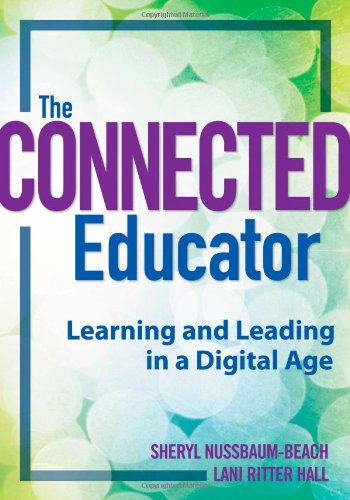
The Connected Educator: Learning and Leading in the Digital Age by Sheryl Nussbaum-Beach and Lani Ritter Hall
This book provides school leaders with a complete review of what it means to engage in the use of social media as a "connected learner." Nussbaum-Beach and Hall take readers through the whole idea of engaging in social media as a means to learn 21st century style. Using the tools of social media allows school leaders to expand their connections to a world beyond the classroom. This book provides a complete model to make global learning and connecting happen.


What School Leaders Need to Know about Digital Technologies and Social Media edited by Scott McLeod and Chris Lehmann
In this collection of essays, edited by educational technology experts Scott McLeod and Chris Lehmann, school leaders get one of the most complete descriptions of the tools of the social media toolbox. This book takes readers through a complete survey of all the tools---from blogs to social bookmarking to even gaming. Readers will find this comprehensive overview of social media tools extremely useful and they plan and development social media strategy.


Personal Learning Networks: Using the Power of Connections to Transform Education by Will Richardson and Rob Mancabelli
Richardson and Mancabelli’s book is one of the most comprehensive and engaging reads yet on the potential of “Personal Learning Networks” as a transformative force in education. This book focuses less on the social media tools and more on the strategies educators can use to foster, not only the development of their own personal learning networks, but also the personal learning networks of the students they teach. As a part of the school leader’s library, this book is an excellent strategy guide for engaging in social media as a means to foster personal learning.


Radically Transparent: Monitoring and Managing Reputations Online by Andy Beal and Judy Strauss
While this is the only book on the list not written specifically for educators, Radically Transparent: Monitoring and Managing Reputations Online is the best guide for school leaders who want to move beyond just using social media as personal learning network tool or as a communication tool. This book provides strategy on how to proactively engage in social media use to foster a positive online reputation. In the 21st century, school leaders can ill-afford to ignore their school or school district’s online reputation. This book provides school leaders with the tools in which to engage social media as public-relations tool and become completely transparent, which is an expectation for 21st century organizations.


Social Media for School Leaders by Brian Dixon
Dixon’s book is another excellent resource on social media for the 21st century school leader. This book gives another comprehensive overview of the social media tools, including some not found in the other books. It also provides readers with a comprehensive framework for understanding how to use social media effectively. Dixon’s books is excellent combination of introduction of the social media tools and the strategies to use to engage in their use effectively.


These seven resources provide school leaders with the most comprehensive view of social media possible. By reading these and referring back to them often, as well as engaging in the use of the tools and the strategies, school leaders can effectively become social media leaders in their schools or districts.


Saturday, March 9, 2013

5 Guidelines for Rational School Leader Response to Social Media Issues

What should be a school leader’s response when a student uses social media in an inappropriate manner? This Winston-Salem Journal Editorial “More Education, Guidelines Needed for Officials, Students on Social Media and School Security,” makes the usual call for more rules and education about improper use of social media. But was this event a “social media problem” or was it “a behavioral or crime problem?” I think the answer to that question is at the heart of how a school leader should respond to a student’s misuse of social media.

The scenario described in the Winston-Salem Journal, states that a 16-year old student used another student’s Facebook page to pose a threat to students and staff at her high school. She was arrested for making a false report and communicating threats, and as the editorial indicates, she faces some serious prison time for her actions which is as it should be. It should be clear though, Facebook does not in any way make this crime any different than using a handwritten note or some other media to make that threat. The crime was not the use of social media. The crime was the action of making threats which is illegal. Making this distinction is at the heart of how a school leader should respond to these kinds of incidents.

If social isn't the issue, what kind of guidance is there for school leaders in situations where students use social media in inappropriate ways? Here’s some suggestions.
  • Deal with the criminal or inappropriate action, not the media. The issue was not whether the threat was communicated through Facebook or not. The issue was that a student made threats to students and staff and under North Carolina law that is illegal. It is important that school leaders focus on the illegal behavior or the problem behavior, not Facebook. Bullying is wrong. Improper communications between a teacher and student is wrong. Whether it occurred on Facebook or the phone is irrelevant except as  simple facts in the case. School leaders need to keep their eyes on the behavior and not delude themselves into thinking that if Facebook would go away, then the problem would not have happened.
  • Follow the same procedures you would follow after finding a threatening note pasted to a restroom wall. Again, the focus is on the criminal activity, not the media. If procedure demands that parents be contacted when a threat to students and staff is made, as soon as the threat is discovered, make that contact. It is important that guidelines focus on the threat, no matter how that threat was communicated. Equally important is that our response always focus on the behavior at issue.
  • Take the lead and educate students so that they understand that criminal behavior (and inappropriate behavior) on social media has the same consequences as it would have anywhere else. Also, educate students on appropriate and inappropriate uses of social media. Students need to understand that their values and morals do apply in online spaces. They need leadership from school administrators in the form of a clear understanding that behavior online that is illegal or improper is still illegal or improper. Don’t make the issue murky by focusing entirely on social media.
  • Be cautious of the usual “knee-jerk” reaction of blaming Facebook and other social media. Social media has undoubtedly complicated our jobs as administrators because of its powerful opportunities to connect our students and staff. But school leaders should not argue for bans because of these complications. Our responsibility is not to make our own jobs easier at the expense of trying restrict the freedom of others. Instead, we need to be reluctant to infringe on students’  and staff’s right to engage in free speech in online spaces. School leaders need to stop looking for “social media boogeymen” and deal with the behavior at issue.
  • Educate yourself about social media. School leaders who deal with social media issues need to make sure they themselves know as much as possible about the media. Knowing how it works and how students and others use it is a key to making sure that responses to problems involving social media are rational.
School leaders do need some guidance on how to respond to inappropriate and criminal activity on social media, but that guidance needs to be based in reason. A rational school leader response to incidents like the one described in the Winston-Salem Journal needs to focus on what the real problems are. The real problems are the illegal and improper behaviors, not the media.