Saturday, August 28, 2010

21st Century Book Review: Milton Chen’s Education Nation

Cover ImageEvery now and then there is one of those books that seem to leap off the shelf into my hands because the title captures the spirit of the moment in the world of public education. Earlier this year, Diane Ravitch’s book The Death and the Life of the Great American School System was one of these books. Milton Chen’s The Education Nation: Six Leading Edges of Innovation in Our Schools is the second book I have read this year that does a great deal to further all the conversation and rhetoric about school reform and innovation. While Ravitch’s book focuses on the misguided path to reform followed the Bush administration and taken up by the current Obama administration, Chen’s book offers some practical suggestions on what directions meaningful reform can take, and what schools of innovation can look like.

Using the logic and ideas of business strategist John Seely Brown, Chen argues that the seeds of school innovation and reform lie at “the edges  of the American education system” where the richest forms of school innovation are occurring. The edges of innovation described by Chen are: the thinking edge, the curriculum edge, the technology edge, the time/place edge, the co-teaching edge and the youth edge. Through the use of examples, Chen describes how each of these edges have the potential to bring about more widespread innovation.

The first edge of innovation described by Chen is “the thinking edge.” According to the author, this is the most fundamental to innovation and it involves “modernizing our thinking about education.” If we want to truly modernize and reform our school system, we need to “change our thinking about the education enterprise itself.” We need to examine the learning process, the role of students, the role of teachers, the role of parents, and the opportunities brought about because of technology. We have to overcome an inertial that wants to hold schools “just like they are” because of nostalgia and memory. As Chen effectively points out, we need to “update our thinking on how children learn best.” He advocates a move toward a more child-centered approach to learning like that described by the education philosopher, John Dewey.

The second edge of innovation described by Chen is “the curriculum edge.” According to Chen, the curriculum edge “represents the growing trend of transforming and reorganizing the most fundamental education activities: what students are taught and how their learning is assessed.”  There is a need to to reorganize the curriculum so that it includes advances of the twenty-first century. What Chen calls the “subject matter silos” prevent content from being relevant to our students. He would argue for more subject-matter integrated approaches to learning content. In addition, assessment should be in the form of project-based learning, rather than bubble-sheet tests. Chen would have us redefine the curriculum to provide students with projects and experiences that are relevant to students’ lives and the modern world.

Chen’s third edge of educational innovation is “the technology edge.” He advocates strongly for the need of getting a computer in the hands of every single student, and has a great deal of admiration for one-to-one computer initiatives. Also, the promise of online learning opportunities in providing high-quality learning to all students is leveling the education playing field. For example, online learning has made it possible to provide learning content to students in isolated rural areas in certain AP subjects that otherwise was once impossible. Chen also points out that technology has brought about what he calls “the death of the lecture.” Technology has made it possible to provide learning in more highly engaging ways. Technology has provided new ways of learning to read. It has also begun to provide powerful opportunities of learning through video games. In word, technology is transforming education at its edges.

The fourth curriculum edge described by Chen is “the time/place edge.” This edge “represents the destruction of the old view that learning happens within the four walls of a classroom, during a set time period each day." This old, persistent view that learning occurs in discrete time periods and in specific places is gradually being eroded away by a new world where learning and school is shifting to an institution that provides learning anytime, anywhere it is needed. Education systems that cling to this twentieth-century factory model of are losing relevance in the twenty-first century. Chen points out that schools are redefining the school day beyond its traditional boundaries. Schools are being kept open later and on Saturdays to provide additional academic support for students, additional recreation opportunities, and additional opportunities for extensive project-based learning. Places of learning are also being redefined. School is moving out into the larger community to take advantage of real-world opportunities of learning. For example, students are growing school gardens to learn about nature, nutrition and the environment. Even our national parks are becoming the classrooms where our students tackle twenty-first century content.

Chen’s fifth curriculum is “the co-teaching edge.” This edge of innovation is transforming the role of teacher and enlisting experts and parents as “coeducators” in the education of children. Chen acknowledges that teachers are the most important factor in the education process, but our policymakers have not acted in a manner consistent with this belief. Legislatures have made professional development funding one of the first areas of the budget to suffer the axe. Calendars are constructed that provide for few opportunities and even less time for ongoing, effective professional development. Even teacher preparation programs haven’t been a priority. They have operated with more limited resources than engineering and business programs in our colleges and universities. For all its talk about the importance of teaching, our own government has not “walked the walk.” Chen also points out that schools can enlist experts in areas such as the arts or technology to assist in providing education for students. Parents should also be enlisted as partners in the education of their children.

The sixth and final edge of innovation described by Chen is “the youth edge.” Our students are “marching through our schools, carrying transformational change in their pockets in the form of powerful multimedia handheld devices.” According to Chen, these young people are forcing innovation due to their use of digital devices. They carry “the reform we seek with them.” But as Chen points out, they still need “caring adults who can lead them to the right digital learning experiences.”

Milton Chen’s Education Nation is in some ways an answer to the question, “What should education reform look like?” Earlier this year, Diane Ravitch’s The Death and the Life of the Great American School System warned educational policymakers about their continued travel down a path of reform that overemphasizes testing and the de-professionalization of the teaching profession. Many critics of Ravitch have argued that she points out the problems, but she does not offer solutions. While that is arguable, one thing is clear. Chen’s book provides many ideas for educational innovation and reform. It is a great addition to the 21st century administrator’s book shelf.

Monday, August 23, 2010

Traditional School-Wide Book Reading: Creating a Culture of Big Ideas

I have been principal at the Newton Conover Health Science High School since January, and I have spent a great deal of time learning the culture of the school. The “Newton School” as it is fondly referred to by students and community members was established five years ago as a high school redesigned based on 5 Purposeful Design Principles delineated by the North Carolina New Schools Project. These 5 principles include: 1) Preparing College-Ready students, 2) Promoting powerful teaching and learning, 3) Personalization of student education experience, 4) Redefined professionalism, and 5) Purposeful design. (For more information on these design principles see here.)

But my post today is not about these design principles, it is about a tradition that was initiated here at the Newton School called “School Wide Reading.” Each summer, every student in the school is assigned one book to read over the course of the summer. The book assigned to our students this summer was the Nation Book Award winning The Absolutely True Diary of a Part-Time Indian by Sherman Alexie. Every student in our school was assigned this book, and during the first days of school, students will be engaged in activities designed to bring about an examination of the book and its themes in light of our school-wide culture. One of the unique characteristics of the culture of the Newton School is the value of discussing ideas called “big ideas.” The school-wide read helps facilitate this discussion. I have finished reading the book in preparation of the first days of school so that I too can be prepared should students wish engage in the discussion of the books ideas with me.

This is the Newton School’s sixth year. Gone is the support provided by the North Carolina New Schools Project. We are now truly on our own, which means the struggles we face every day now are going to be to keep certain positive aspects of the culture alive, like the school-wide read. The culture at-large still expects its high schools to fit a certain mold, so schools like the Newton School are expected to become like the one down the road. We must constantly remind both ourselves and others, the value in our school is that we can engage students in an educational experience that still embodies what is valuable in the 5 Design Principles on which we were founded.

As we move into this sixth year, and away from our relationship to the North Carolina New Schools Project, traditions like the school-wide read must be kept alive, not because the tradition by itself is valuable, but because it is one cultural component that says we are different. Successful high schools have an identity that distinctly separates them from others, and that identity is defined by the traditions of its culture whether positive or negative. If our high schools want to become places of learning in the 21st century, we must create and maintain solid cultural traditions in our schools that define places where students are valued and learning is treasured. We them must tenaciously defend that culture from the inertia of a society that forces schools at the edge of innovation to become clones of the 20th century school. Our school wide read is one of many aspects of our culture that defines who we are, and as we begin this new year, we embrace it fully.

Sunday, August 22, 2010

My Blog Redesign

My apologies for the change in my blog design. I realize I just changed it a month or so ago, but for some reason I was never happy with that design. This weekend, I decided to try a new design that I thought more fitting. I hope it works much better than the other design.

It’s Time for Move Our Teaching into 21st Century: Lessons from a Computer Virus

This past weekend, I spent several hours trying to rid my family desktop computer from a particularly nasty trojan virus. This particular virus posed as antivirus software which someone in the family inadvertently installed when a pop-up came up warning them that the computer was infected. What made it extremely difficult to eradicate was that whoever engineered this particular virus apparently had thought of all the ways I had rid my computer of viruses in the past. As I searched for a solution, I tried many of my old tried-and-true tactics, only to find that solution would not work. This went on for several hours, until I realized none of the tools in my current toolbox would work. I told a family member at the time, “This is one of the worst computer bugs I have seen. It’s like it knows my every move and it blocks it.” I spent an entire Friday evening trying to get rid of it, finally surrendering at 3:00 AM, with the computer still infected.

The next day, I did some web surfing, and by searching with Google Images, I found an exact image of the fake antivirus messages on one of these computer forums devoted to do-it-yourself computer troubleshooters like myself. I read the solution presented there, and it looked similar to another one tried the night before, so I decided to look for other options. I even looked up the Best Buy Geek Squad to see what they could do for me, and their web site stated that they could get rid of the trojan virus for about 200 dollars. I decided that would be my final fallback position. I wanted to try to solve this problem myself before spending that much money on it. The computer was not usable in its current state, so I doubted I could do anything to make it any less usable. To make the story shorter, I used the instructions from the computer forum and the suggested freeware tools provided, and by that afternoon, I had cleaned the virus from the computer, installed up-to-date antivirus software, installed a malware blocker, and optimized the whole system.

I share this incident, not to brag about my computer wizardry, though it does make me feel pretty good to have solved a very complicated problem like this one. I share this incident because it illustrates, at least to me, all the kinds of thinking our schools should be having students engage in. I began with observation---examining how my computer was affected by the virus. Next, I gathered information about the problem. I used the Internet and Google search to find out if anyone else had problems similar to mine. After I discovered information about the problem from the Web, I began to evaluate the usefulness of the information and the solutions offered. I hypothesized which solutions would work given the aspects of how the virus affected my computer. Then I began testing the solutions to see if they would work. When none of the solutions would work, I had to reframe the problem: I can’t just get rid of the virus, I have to disable it first. Finally, I found new solutions to fit the new way I had reframed the problem. Ultimately, I was able to solve the virus problem.

This computer virus aggravated me to the point of muttering a few expletives, but as I think about it now, I think we are past trying make arguments about providing students with a 21st century education. Our failure to provide engaging real-world 21st century learning experiences that ask them solve real problems is now mal-practice. Admittedly, my problem solving venture was successful because of a tiny bit of luck combined with a whole lot of experience solving computer problems, but if we want our students to be able to think critically and solve problems, then we need to give them lots of opportunities to do so, and does not involve textbook exercises or bubble sheets.

Wednesday, August 18, 2010

Secretary Duncan: Cheerleader for the LA Times

I have started to write this post several times. A few of those times, I began trying to write a well-written reasoned argument to what's wrong with the LA Times releasing test scores of individual teachers, but others say it much better that I could. Larry Ferlazzo does a great job tracking all the posts on the Internet focusing on this issue. There are also those who do a much better job at pointing out the foibles and foolishness of Secretary of Education Arne Duncan. Bill Ferriter over at the Tempered Radical probably describes it best: "Arne Duncan Is Just Plain Clueless." What can I add to the discussion? Maybe not a great deal, but I went back to take a look at posts I have made concerning Secretary Duncan, and I have always thought he was a light-weight who has never had an original idea he could call his own. His reforms will do irreversible damage to public education, and it is his fault that the national dialogue has become so nasty regarding education in general and teaching in particular. Just for the fun of it, I thought I would share all my previous posts about the man of our ridicule.

Arne Duncan's Quiet Revolution: The Duncanization of the Great American School System

Secretary Duncan's Video to Principals: You Judge the Message

Taking Back the Reform Conversation from the Politicians

Lack of Support for Race to the Top Does Not Mean Lack of Support for Reform

Reflections on Winners and Losers for the Race to the Top Funding

Callousness of the Obama Administration and Mal-Practice of Secretary Arne Duncan

Race to the Top: Four More Years of NCLB Education Policy ??? Thank You Mr. Duncan!

So, I think it's obvious I'm no fan of Secretary Duncan. Perhaps I've said all I can say about him. I'm not sure. But I do think he's probably severed any good will he might have had left with his enthusiastic support of the LA Times. I wonder if I could nominate him for Keith Olbermann's Worst Person in the World?

Sunday, August 15, 2010

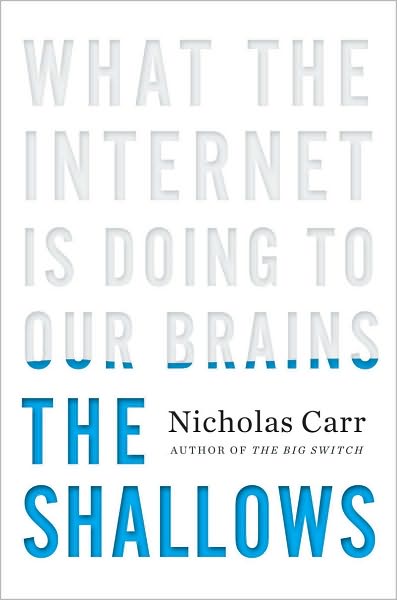
21st Century Book Review: Nicholas Carr’s The Shallows: What the Internet Is Doing to Our Brains

Cover ImageBefore this book was published, I looked forward to getting a copy with anticipation. I have been fascinated with what researchers are saying about the effects of the Web on our brains and and thought processes. Disappointingly, this book offers no groundbreaking insights in this topic, and for that matter any other. Carr opens the first chapters of this book with a long tedious history of the printed word and how that has affected thought and information processing. While this might be vital to his argument about how the Internet is changing the brain, it seems to go on forever. Could this information not been condensed into a chapter or so? Once Carr gets to the research on how the Web is changing our brains, he seems to go into long-drawn out descriptions of chemical processes and descriptions of physiological descriptions of how the Web is basically making us shallow thinkers, unable to think deeply about what we read and see on the Net. I was just a bit disappointed by Carr's treatment of a subject that has a great deal of merit, and a subject that needs to be discussed. In the end, this was one of those books that was difficult to finish. Plowing is the accurate term to describe how I moved through this book. While Carr does an adequate job of describing what the research says about how the Web is changing us, he does so in an uninspiring and didactic manner. This could have been an interesting book, but it reads too much like a diatribe against technology in general.

Saturday, August 14, 2010

Four 21st Century Tech Tools I Don’t Use: They Haven’t Made the Cut

Recently a comment from Miguel Guhlin (@mguhlin on Twitter) made to my post about My Five Favorite 21st Century Administrator Tools set me to thinking. His question seemed to be a time management question regarding how is time for testing new tools balanced with the other priorities in life. I know the answer to that question for myself, but I can’t possibly answer it for others. I do spend a great deal of time trying out the new technology tools being unveiled almost every day, and to me that is a priority. But my other priorities do not suffer because I seem to forego things like watching TV and movies, which was once a favorite activity, to spend time in tech-exploration.

As I thought about the question though, I thought about all of the Tech Tools I have explored that have not made their way in my daily use. That does not mean they aren’t useful, nor does it mean they are not good solutions for others. It means that I have found other solutions that work more seamlessly in my daily routine. I would certainly encourage others to try these tools for themselves. We all have our own preferences and needs, which means what works for one person will not work for others. Learning from my list of tech-tools-that-haven’t-made-the-cut is just as beneficial as lists of my favorite tools. The beauty of computer technology is that we can customize the environment to our own needs.

Tech-tools I’ve Tried But abandoned

This list is not everything, but I will share a few. I would encourage others to try them out. They might work for others, and please do not take this list as disparaging these tools. In most cases I have abandoned an electronic tool only to discover a use for it later.

Task Coach

Task Coach is an Open Source task management solution. It is really powerful. It provides users with the ability to manage complex tasks that require sub-tasks. For someone who finds completing a great deal of projects with a myriad of sub-tasks rountine, this might be a solution. For my purposes, the simple Task List in Google Apps is sufficient, because I do not find myself managing projects that involve many sub-categories of tasks. For more information about Task Coach and for download: http://www.taskcoach.org/.


Netvibes

I tried Netvibes after reading about it on a blog. It looked intriguing and I liked the idea of combining all of my social media feeds on one page, and the ability to organize my RSS feeds into Tabs laid out like a newspaper page. I tried it for a few days, and I even wrote about it here. But so far, it has not made it into my regular tool box. First of all, I do not like the way the feeds load. They only load when you click on the tabs. I have my RSS feeds placed into tabs according to categories like “Ed Tech.” I also found that I like the ability to view my “All Friends” feed and “Mention Feeds” side by side. I suppose I’ve gotten use to that because of TweetDeck. In the Netvibes Twitter Gadget, I have to click on a tab to load my “mentions” feed. That doesn’t work for me. I liked the ability to share blog posts in Netvibes. All that you have to do is read the post and just click on share, but to be honest, I wonder if it didn’t make the sharing too easy. Now, when I read a post in Google Reader I have to make effort to download the blog post and then copy and paste it into TweetDeck. This seems to make me a bit more discriminating about the posts I share with my PLN. In Netvibes, clicking the share button makes it so simple to share, the temptation is to click the share button every time. Don’t get me wrong, I still have my Netvibes account, and will continue to toy with it, but for now, it is not an everyday tech tool for me. Try out Netvibes here: http://www.netvibes.com.

Freemind

Mind mapping tools are a personal favorite for me. I often use them to take notes while reading an interesting book, or I will use it to map out a presentation that I am going to make in the future. I have used Freemind, Xmind, NovaMind, Mindjet Mindmanager, and Inspiration. I continue to use Xmind, Mindjet Mindmanager, and Inspiration, but I found Freemind not very user friendly. NovaMind might be a good product, but I already had purchased Xmind, Mindjet Mindmanager, and Inspiration, and a NovaMind purchase seemed excessive. But Freemind is the open source program, but it fails to deliver what I like in the others. All three products that I use either give you the ability to enter a presentation mode, or convert your slides to a presentation. Freemind does not allow that. I honestly do not feel it to be as easy to use as the others. Download and try Freemind here: http://freemind.sourceforge.net/wiki/index.php/Main_Page.

Remember the Milk

I recently mentioned Remember the Milk in a presentation on tech tools for task management. The truth is, I once upon a time used this Web 2.0 to maintain my to-do lists. I even installed the gadget that integrates it with Google Calendar. But my use of this tool stopped when I found Google’s own task list easier. For me, simplicity in a tech-tool is a virtue. Just like Task Coach, Remember the Milk is just not simple enough for my needs. I tend to navigate toward simplicity in the tools I use. The to-do list I need needs to be simple, even simpler than Remember the Milk. Check out Remember the Milk here: http://www.rememberthemilk.com/.


When I started this post, I had planned to offer five tools that haven’t made the cut, but I honestly could not decide what the fifth tool would be. There are several tools I have used, but have not made part of my toolbox, but I am still exploring these tools. For example, one of these is PiratePad. It has the simplicity, and I have tried it, but I am not sure I have taken it through the paces of the four tools above. In all fairness, these four tools are found to be quite useful for others, so I encourage anyone to try them out. One of the features of computer technology I value is the ability to customize its functionality to my own preferences. Choosing the tools that are the best fit for me is why I use technology so heavily.